The Blake Society
Find us on Facebook
  • Home
  • About
  • Blake Events
  • Committee
  • Exhibition Space
  • Blog

Wes Anderson, and a lot of pink.

3/12/2014

0 Comments

 
So in the spirit of end-of-term, dissertation-what-dissertation delight, the other day I went to the Arts Picturehouse just outside Downing and saw Wes Anderson’s ‘The Grand Budapest Hotel’. The trailer itself is just brilliant, and the film lives up to that, an ornate and thrilling story-within-a-story-within-a-story which unravels against the mountainous backdrop of the imaginary former Republic of Zubrowska, and its premier (and very pink) Hotel, the Grand Budapest. 

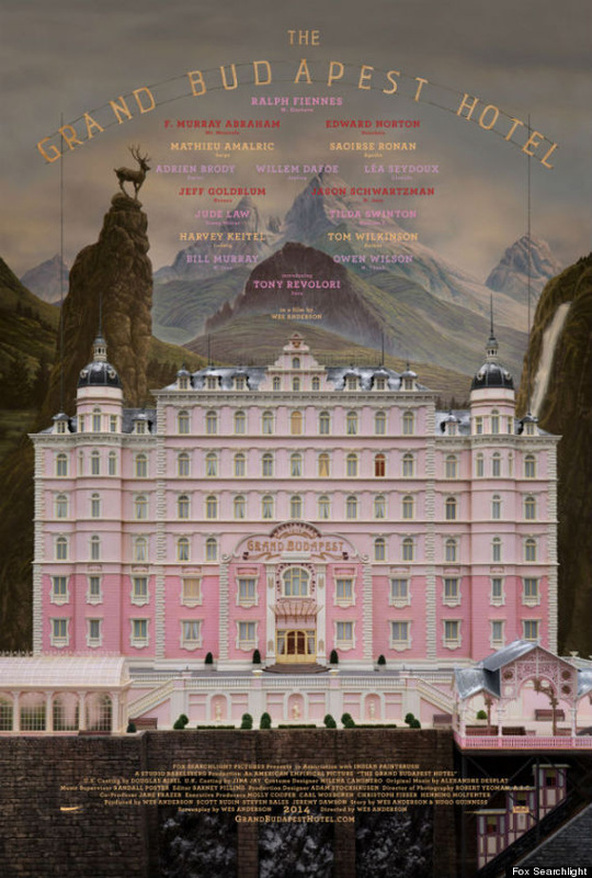
I don’t want to spoil it for you, though. It’s not the story I want to talk about (go and see it!) - it’s all that pink. The Grand Budapest Hotel is one of Wes Anderson’s most visually stunning films, in an ouvre packed with them. My particular favourite image is there on the film poster - a doll’s-house version of the hotel, resembling confectionery in its incredible, multiple-tiered pinkness, all topped off with a big, arched sign giving its name. Set against the backdrop of dramatic mountains (complete with stag), it’s a mirage, surreal and brilliant - and it’s the work of graphic designer Annie Atkins, who created the poster, alongside every single graphic prop in the entire film. 
Picture
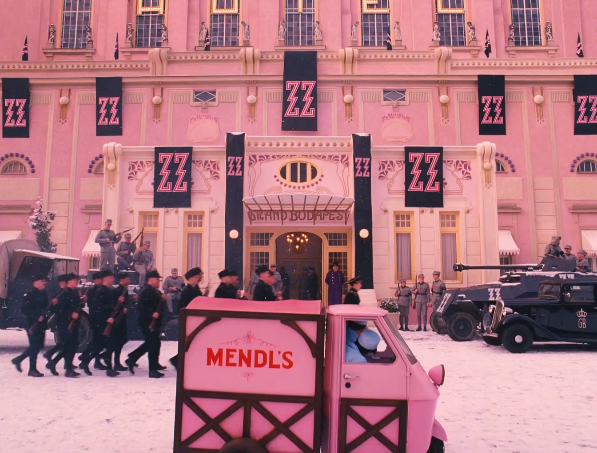
This is a text-heavy film. There are signs, newspapers, death certificates, police reports, an entire box of letters making up a last will and testament - and hundreds of pink confectionery boxes, each bearing the legend ‘Mendl’s’, and according to Atkins the most coveted set steal for cast and crew. The boxes echo the pink of the hotel itself, another surreal, sugary interjection into a film which sets itself against the rumblings of war. One of the final scenes, in which ‘ZZ’ military personell have overrun the hotel, is particularly striking; the protagonists pose as Mendl’s delivery drivers in order to get inside, and the audience is treated to the sight of a black-armbanded ‘ZZ’ officer staring at a pile of cake boxes, his mouth smeared with pastel icing. The 'ZZ' font on the banners outside even becomes pink-tinted; evidently, even this fascist organisation is not immune to the powers of luxury and excess, which both Mendl's and the Grand Budapest come to represent. 
Picture
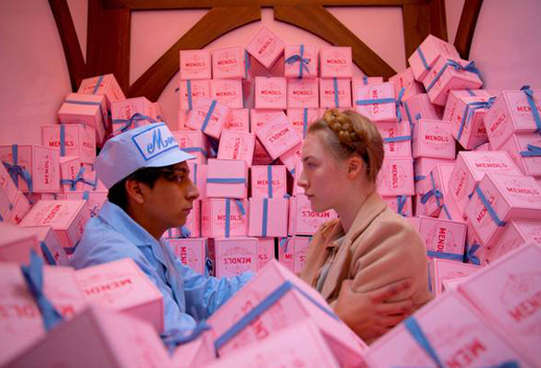
Another wonderful moment (soon to be occupying the Pinterests, Tumblrs, and bedroom walls of everyone ever) is a point at which two major characters have just fallen from a ledge and come to a major realisation - landing in the back of the Mendl's delivery van, amid box after box of cake. 
Picture
The fantasy perpetuated by both the hotel and the confectioner's is presented as unsustainable from the beginning, one of the two framing devices showing the Grand Budapest in its faded state under communist rule; and yet it is just this fleeting instability which makes the entire mirage so successful, the pastel colours heightened, one imagines, by the storyteller's nostalgia. 

It's a wonderful film, the touches of tragicomedy just catching all that pink before it topples over into schmaltz - go and see it!
0 Comments

A Little Women's Day Whine

3/8/2014

0 Comments


In case the deluge of feminist tweets and Facebook posts has passed you by, today is International Women’s Day and, as it comes to a close, I must admit that I am quite underwhelmed by the reception it’s had in the UK. Admittedly, this is for the quite selfish reason that me and my fellow ladies have not been showered with gifts, attention, and all round admiration. I mean, surely we deserve at least that for going through all those periods, all that waxing, all that childbearing…

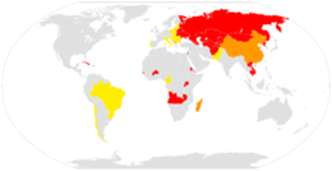
Okay, I’m being a tad melodramatic. But, seriously, we could step it up a notch. I did a bit of digging into IWD traditions in other countries and found that in many places today is an official holiday…not in the UK, though. (The red countries on the map have official holidays, the orange official holidays for women, and the yellow unofficial holidays). 


Picture
What’s even more upsetting is that apparently a lot of gals are getting showered with flowers today, as reward for possessing a womb. In Italy, the guys all go out gifting yellow mimosas to the surrounding ladies, and in France it’s violets and lilies-of-the-valley which dominate the day. I like violets…and mimosas and lilies, now that I come to think of it. Also, did you know…‘mimosa’ translates to Buck’s Fizz in Italian, so don’t worry, chaps; if you haven’t got any mimosa’s lying around, some Buck’s Fizz will do me just fine!

In all seriousness, today is a vital commemoration of the struggles of women worldwide; historical and in the present day. We might not have days off, or flowers here, but we do have far more freedom and equality than a lot of women around the world, so please spare a thought for those less fortunate and, if you have the time, maybe do a little something to support them…

http://policy-practice.oxfam.org.uk/our-work/gender-justice/international-womens-day?intcmp=hp_318_hych3_iwd_2014-03-07


Miriam Goode
0 Comments

Different Perspectives

3/4/2014

0 Comments

 
PictureI admit it, I'm a bit of a fan-girl
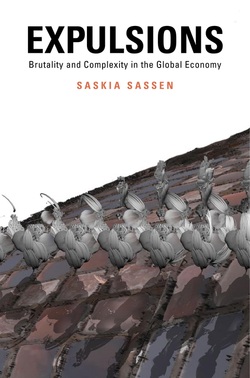
A couple of weeks ago, I went to a talk by Saskia Sassen, who is a ‘big cheese’ on topics like globalisation and global cities, and generally well known for questioning current notions on economic geography whilst pushing for new perspectives. For her newest book, ‘Expulsions’, she argues that we need a new language and conceptual framework surrounding development and growth, and seriously questions the acceptance that increased inequality is an inevitable result of it. Here, she shows the potential for never accepting the ‘system’ as the right, or indeed only way – our economy is a social construct, therefore can be socially 'deconstructed' and rebuilt. 

There is always potential to look at things from a different perspective, and looking at cases that lie beyond the ‘systemic edges’, is a good way to approach this. Reminding ourselves that the current discourse on economic growth doesn’t, in fact, apply to every scenario, reminds us of its incompleteness, and the need to develop new categories of thought to challenge the dominant channel. Here, she provides a useful analogy of a streetlamp: the ‘light’ of the lamp might be powerful, but it is important to ask yourself what it might be keeping you from seeing. What lies in the shadows?

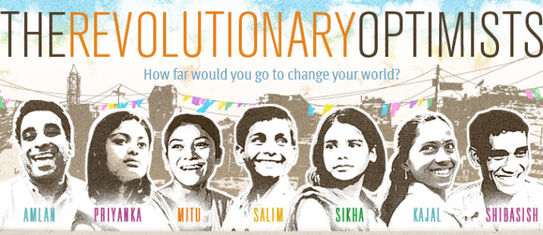
‘Shadow’ case studies are useful in questioning the system, but what can we do to build alternate discourses? Here, Saskia questions the middle class’ potential to ‘make’ the social, as they have become passive consumers in their relatively comfortable lives. The elite will, of course, always have power in shaping social norms and thought, but what about those at the ‘bottom’? Having to fight for their place in society makes them well equipped for creating alternative narratives, Saskia argues, and their revolutionary potential makes spaces like slums anything but powerless, as they are often seen to be (summed up well in this short trailer of a film on 'Revolutionary Optimists'). 

Picture
So, let’s take this notion of ‘bottom up’ change and apply it to something else (because this is getting a bit economics-heavy for a Blake blog, isn't it?). What about art? As part of my dissertation research on the identity formation of young Muslim girls in London, I was lucky enough to speak to Sadiya Ahmed, the founder of a new and exciting project called Everyday Muslim. This project is a celebration and development of heritage amongst Muslims living in East London, which is currently largely unrecognised despite a large Muslim population living in the area. 
PictureDeveloping a sense of personal history and 'place' in British society
Sadiya and her colleagues are working with local museums to put together exhibitions on the topic, but what I find most interesting is their efforts to change what people think of heritage. They argue it is important for people to realise that objects don’t have to be in a museum or gallery to be part of a community’s history or identity, and indeed it is the everyday objects all around us that are most important. To get people to recognise this, Sadiya argues, is to get them to realise that their heritage is everywhere, and that they can take pride in and interact with it regardless of its presence in more ‘traditional’ spaces. 

An example of their work is to work with the E17 art trail (which I wrote about in my first blog post!) this summer, focussing on the interior design of Islamic houses in the area, and also running sessions where people bring a small item like a photograph or ornament that they feel represents who they are. 

I enjoy this idea of questioning traditional concepts of ‘art’ or ‘history’, and working with communities that may suffer exclusion and discrimination to build alternative narratives. Art should be seen as something that is everywhere, that we can relate to and interact with, not just something we stare at in galleries whilst desperately thinking of something ‘intellectual’ to say. To conclude, then, let’s all try and be a bit more difficult – that is to say, let’s stop passively accepting things as they are, or what we can see in the ‘light’. If things don’t seem quite right, let’s question them, and always push to see what exactly lies in the ‘shadows’. Bit of a grand ending, but perhaps a point worth making! 

0 Comments

Oodles of Doodles (Part 2)

3/1/2014

0 Comments

 
The second part of this blog entry has been a long time coming, but here it is: Part 2 of my procrastinating insight into the world of scribblings... 
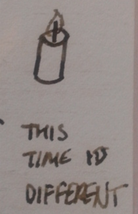
PictureI've kissed worse.
In Part 1, I despaired at my inartistic inclinations which led me to explore what little art I did -  the little arts in my note margins. This was actually a lot more widespread than I thought, and some common motifs occurred again and again. But with so much more to say I promised to continue to write more. And now a year later, here it is:

Once I had taken on my adventure through the tumult of drawings, I did begin to feel slightly concerned. Maybe I shouldn’t be spending quite so much time in when I’m supposed to be learning embellishing my margins. So I did what any self-respecting student gets concerned that they’ve made the wrong choices in life: I Googled it. And upon inputting ‘concentration’ and ‘doodling’ and one of the top results was the PDF of a psychological study which not only promised to answer my question but suggested the possibility that doodling could be potentially helpful (!!!).


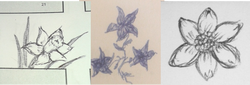
PictureFlowers - a common feature of my boredom.
Upon further reading, it would appear the psychologists in question had performed a study where participants upon completing a previous study were asked if they could just stay five minutes longer in order to help with another. They were asked to listen to a tape of a phone call about a party. Warned that it would long and dull, the participants were told not to worry about remembering anything - all they had to do was write down the names of those who would probably be attending and nothing else. The participants were split up into two groups -  one set were also asked to shade in shapes whilst completing the task, being told it didn’t matter it was to help alleviate boredom. After listening, both groups were asked if they could recall information from the call.

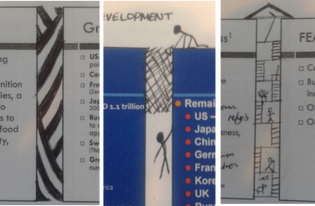
PictureThe gaps between slides are easy to fill.
On average, doodlers performed a lot better at the task, being able to passively recall more information. One of the reasons suggested for this was that doodling helps prevent daydreaming. Doodling allows concentration on a separate task without detracting from the verbal processing resources needed for listening. Daydreaming however appears to be much more distracting. If you are supposed to be copying notes from a book and instead decide to doodle this is of course unhelpful, but the research suggests that during something like a lecture or a conversation doodling prevents you from daydreaming. So although not definitively better than concentrating, if boredom does hit, doodling can help you reduce your lack of concentration. I hope. But moving on…

Picture
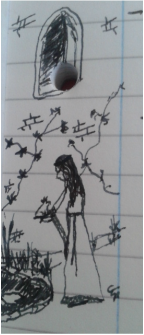
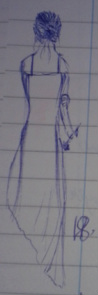
I also expressed in my first doodling exposé, my concern on whether my doodles put my feminism* into question. Not because I’ve been lovingly doodling pictures of the patriarchy, but more to do with the proliferation of damsel-in-distress, ballgowned princesses and faceless women in quasi-bride’s dresses. As I sat and learnt about economics and soil erosion, was I secretly dreaming that my knight-in-shining-armour would ride into the lecture hall, to carry me away to live a life of domesticated, wedded bliss? But after admiring the varying females, I reassured myself with the fact that more likely I was doodling fairytales as escapism from work rather than as an alternative lifestyle choice - me drawing lovely flowing dresses is probably more in response to the fact that I’m thinking of May Week rather than me subconsciously eschewing the values of my trousers-wearing, liberated sisters. However this entire conundrum is probably a prime example of the dangers of reading too much into your doodles (meta-procrastinating!!!) which the internet is more than happy to do for you.


Picture
So what have we learnt on this long-winded journey into the pointless scribbles of my life? Apart from my ability to reassure myself repeatedly of my actions. That I enjoy doodling way too much? Probably. Could doodling be constructive? Possibly. Ultimately, doodling could be an effective technique to keep your concentration next time you are stuck in a lecture that just makes you want to fall asleep. But maybe don’t do it in supervisions. Or at least not when the supervisor can see your notes.

Georgina Phillips


*DISCLAIMER: Obviously as a third-wave feminist, I do not believe their is an 'ideal woman' - feminist or otherwise - that people should aspire to; feminism should be about respecting women's choices and providing an environment where women can make and develop such educated choices. So if you want to be a damsel in distress, I respect your right to that choice. But I might question it's efficacy. And obviously feminists can wear dresses.


0 Comments
    Picture

    Author.

    The Blake Society is THE Downing College society for all arts and humanities students and anyone interested in arts-type things.

    Archives

    February 2016
    November 2015
    October 2015
    December 2014
    November 2014
    October 2014
    June 2014
    May 2014
    March 2014
    February 2014
    January 2014
    December 2013
    November 2013
    October 2013
    June 2013
    May 2013
    April 2013
    March 2013
    February 2013
    January 2013
    December 2012
    November 2012
    October 2012
    September 2012
    August 2012

Powered by Create your own unique website with customizable templates.